How is the TPACK framework useful in the development of classroom technology skills?
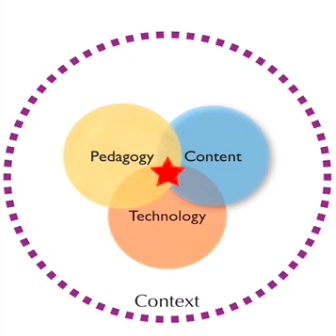
Technological Pedagogical Content Knowledge (TPACK) is indicated by the red star placed where all three bodies of knowledge intersect in the Venn Diagram. Technological, pedagogical and content knowledge need to be framed within a given context which is depicted by the dotted purple circle that encloses the Venn Diagram. Together these components represent a framework available to teachers for technology integration (Koehler & Mishra, 2009).
One of the key points Koeler and Mishra (2009) emphasise about technology integration is that there is no ‘one best way’ to integrate technology into the curriculum.
“…integration efforts should be creatively designed or structured for particular subject matter ideas in specific classroom contexts.”
Koehler & Mishra, 2009, p.62
The framework gives teachers the freedom to use their skills to integrate technology creatively within their own classroom context. What is really significant about this aspect of the framework is that it acknowledges that all teachers will have varying levels of knowledge for each framework component. So no matter what stage you are within your teaching career the framework is relevant to assist with the development of classroom technology skills.
Nearing the end of a Bachelor of Education (K-12), and the end of a classroom technologies subject, my TPACK knowledge as whole has increased somewhat in all aspects since the beginning of the degree. At the moment I would say, compared to where I want to be, that I would have strong theoretical Pedagogical content knowledge (PCK) compared to having a strong practical PCK. I have indicated this in Figure 1.
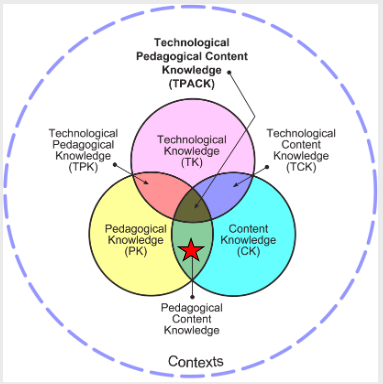
Throughout the classroom technologies subject, I have realised that I need to increase my technological knowledge (TK) to increase my TPACK as a whole. It is also important, however, to keep in mind the level of knowledge in all three components depends on a specific context. The context I am referring to is my knowledge of TPACK in general. As I progress in my career the development of my classroom technology skills for certain contexts, and as a whole, will increase both theoretically and practically with experience.
The TPACK framework is also referred to as “Tech-PACK” and used by Roblyer and Doering (2014) within the technology integration planning (TIP) model. The TIP model aims to ensure that technology use is meaningful, efficient, and successful in meeting needs of students through three phases. Roblyer and Doering (2014) incorporates TPACK as a component of the first phase where teachers assess their knowledge within each component for a specific context which is demonstrate in a number of case studies. The case studies are a really useful demonstration of how TPACK can be used to assist teachers’ develop classroom technology skills.
References
Kohler, M. (2013, September 12). Mishra & Koehler (2008) – Site 2008 Keynote Address [screenshot]. Retrieved from https://www.youtube.com/watch?v=1iCPLTz7Z-Q
Koehler, M. J., & Mishra, P. (2009). What is technological pedagogical content knowledge? Contemporary Issues in Technology and Teacher Education, 9(1). Retrieved from https://www.citejournal.org/volume-9/issue-1-09/general/what-is-technological-pedagogicalcontent-knowledge
Roblyer, M., & Doering, A. (2014). Integrating educational technology into teaching. Harlow, England: Pearson.

 ESC407: Classroom Technologies